Initialization
QuickSR supports 3 different ways to fill the initial population.
Grow Initialization
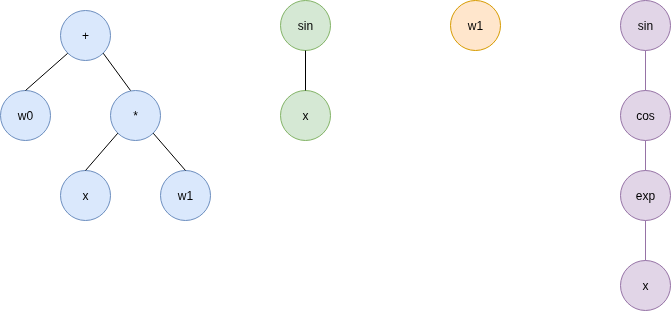
This initialization strategy generates individuals by randomly selecting terminals and functions until the maximum depth is reached or until a terminal is chosen. The resulting trees have varying structure and size. Usage:
initialization=GrowInitialization()
The smallest depth is one, meaning that some individuals can consist of just a terminal.
The maximum depth is normally determined by the global configuration, which is also the highest depth to which expressions can ever grow. However, this upper bound may be considered too high for initialization. Therefore, the initial maximum depth can be overriden using the init_depth parameter:
initialization=GrowInitialization(init_depth=4)
Here is an example population generated with grow initialization (depth 4):
Full Initialization
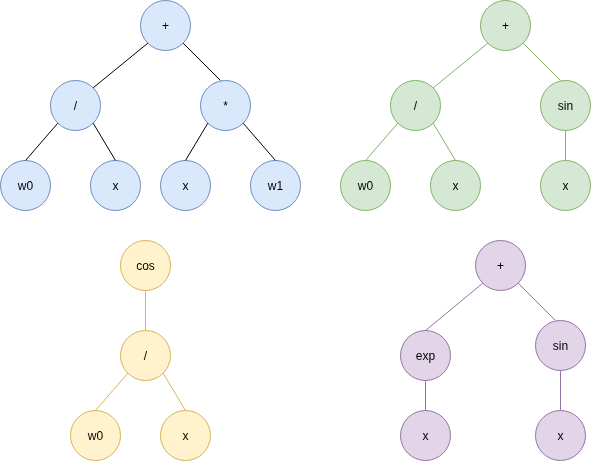
This initialization strategy generates individuals by randomly selecting functions and terminals until the maximum depth is reached in every branch of a generated tree. The resulting trees are fully grown. All of the generated expressions have the exact same depth. Usage:
initialization=FullInitialization()
Similar to the previous case, the depth is normally inherited from the global configuration, but this can be overriden by explicitly specifying an init_depth value:
initialization=FullInitialization(init_depth=3)
Here is an example population generated with full initialization (depth 3):
Ramped Half and Half Initialization
Half of the initial population consist of individuals produced by Grow Initialization, while the other half consist of individuals produced by Full Initialization. Usage:
initialization=RampedHalfAndHalfInitialization()
init_depth can be used override maximum depth as before: